
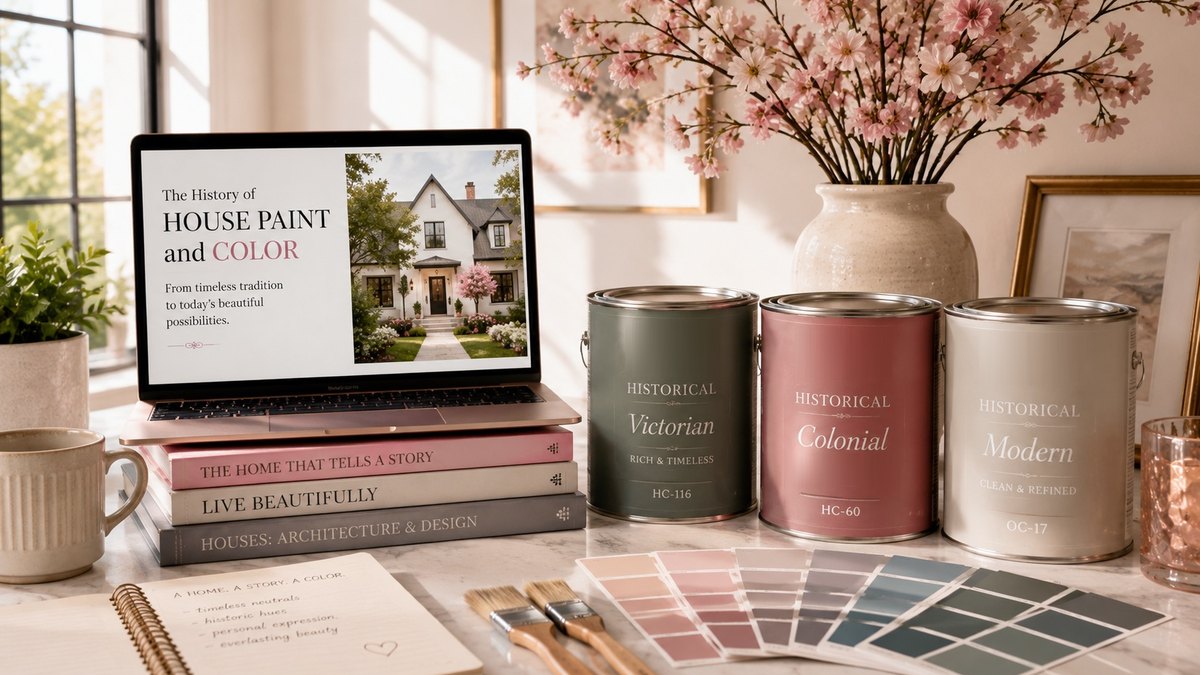
Two questions I get constantly. What color should I paint before I list, and is it true that a black front door adds six thousand dollars? The second one has a real study behind it and the study says something rather different from what gets quoted. But first I want to tell you how paint was made before it came in a can, because the answer involves manure and it is worth knowing what we escaped.
For roughly 2,300 years, the dominant white pigment in the Western world was basic lead carbonate. The “Dutch method” of making it was described by Theophrastus around 300 BC, and Pliny the Elder and Vitruvius described it too.
Here is how it was made, and it did not fundamentally change for two millennia. Thin sheets of lead were placed over pots containing a little vinegar, stacked up, and covered with decaying dung and spent tanner’s bark, which supplied the carbon dioxide. The stack sat for six to fourteen weeks. A white crust formed on the lead, was scraped off, and was ground into pigment.
Why did it dominate for so long? Opacity, and the satiny smooth mixture it made with drying oils. It also worked as an oil-drying agent, accelerated drying, increased durability and resisted moisture-driven corrosion. It was, in every respect but one, a superb product.
Casein — milk protein — plus lime and pigment. A mixture of bovid milk and ochre was applied to a stone tool in South Africa roughly 49,000 years ago. Egyptians used goat’s milk as a binder on lacquer in Tutankhamun’s tomb.
And here is the fact that surprised me: before acrylics, most house paint binders that were not made from oil used casein instead, and it was manufactured industrially. Cheaper oil- and petroleum-based products displaced it. It dries matte and becomes water-resistant as it ages.
Slaked lime or chalk, which cures by reacting with atmospheric carbon dioxide to form calcium carbonate — it literally turns back into stone on your wall.
What people mixed into it tells you how improvised it was: water glass, animal glue, egg white, Portland cement, salt, soap, milk, flour, molasses, alum and soil. For color: pig’s blood produced the traditional Suffolk pink, and blue laundry dye was used for tinting.
It was used because it was nearly free, and because it is mildly antibacterial, which made it standard in dairies and barns. The American saying does the rest of the work:
“Too proud to whitewash and too poor to paint.”
I went looking for period pigment price lists and could not find one, so I am not going to invent numbers. The honest generalisation: earth pigments — ochres, umbers, siennas — were cheap because they were dug out of the ground, and bright blues and greens were expensive because they had to be manufactured or imported.
Here is a correction, because I believed the wrong version myself until I checked. Sherwin-Williams did not invent ready-mixed paint.
D.R. Averill patented the first prepared or “ready mixed” paint in the United States on July 16, 1867, patent no. 66,773. The claim was for “a liquid oleaginous paint, prepared ready for use” that stayed fluid and usable without on-site mixing. The problem it solved is stated right in the patent: conventional paints required ingredients “carefully and skillfully mixed” and then separated in storage, becoming “unfit for use without regrinding or remixing.”
One nice discrepancy: the American Coatings Association says Averill was “of Ohio.” The patent record says New Gentleville, Oswego County, New York. The patent is the better authority.
Sherwin-Williams was founded in 1866 in Cleveland by Henry Sherwin and Edward Williams. Its first ready-mixed paint came out in 1873 by the company’s own account, under the marvellous product name Guaranteed Strictly Pure Raw Umber in Oil. Case Western Reserve University’s Encyclopedia of Cleveland History says 1875. Both are reputable; I am not going to silently pick one.
But the invention that actually mattered came four years later. In 1877, Sherwin-Williams patented the first resealable paint can.
Think about that for a second. Ready-mixed paint you cannot close again is a one-use product. You buy a gallon, you use a quart, and the rest is gone. The resealable can is what turned paint from a tradesman’s material into something a homeowner could buy on a Saturday, use half of, and put on a shelf. Every DIY project in the last 150 years runs through that patent.
The thing that gets me about lead paint is not that it was used. It is that everybody knew.
| Year | What was known |
|---|---|
| Medieval | Texts warn of “apoplexy, epilepsy, and paralysis” from working with lead white |
| 1786 | Benjamin Franklin writes to a friend warning of lead paint hazards, which he considered well-established |
| 1886 | Germany bars women and children from lead paint manufacturing |
| July 1904 | Sherwin-Williams itself publishes that a French expert deemed lead paint “poisonous in a large degree, both for the workmen and for the inhabitants” |
| 1909 | France bans lead paint for interior and exterior building use |
| 1921 | The League of Nations begins working toward a ban |
| Feb 27, 1978 | The United States bans lead paint in residential property |
| 1992 | The UK bans it from general sale |
| 2009 | U.S. threshold tightened from 0.06% to 0.009% |
The largest American paint company published a warning about lead in 1904 — seventy-four years before the United States banned it in homes, and France beat America to a ban by sixty-nine years.
This one gets stated wrong constantly, including by people in my industry. The U.S. residential lead paint ban is 16 CFR Part 1303, issued by the Consumer Product Safety Commission under the Consumer Product Safety Act, effective February 27, 1978.
The EPA owns a different and later thing: the Renovation, Repair and Painting (RRP) rule, which governs what contractors do with lead paint that is already on the walls. The two agencies split the job. CPSC banned the product; EPA regulates the disturbance of it.
This matters here, because Fort Worth has a great deal of pre-1978 housing.
Homeowners doing work in their own homes are not required to be certified. The lead dust does not know that. It is the primary exposure route for children, and sanding and scraping is what generates it.
There are two real studies, both from Zillow, and I am going to give you the numbers and the four reasons to be careful with them — because the numbers get quoted everywhere and the caveats never do.
Over 135,000 listing photos, homes sold January 2010 to May 2018, controlled for other wall colors within each room type, square footage, home age, and ZIP code home values in the listing month. Baseline: white walls.
| Room | Color | Effect |
|---|---|---|
| Front door | Black | +$6,271 |
| Living room | Light taupe | +$2,793 |
| Bathroom | Light blue | +$2,786 |
| Kitchen | Black or dark navy lower cabinets | +$1,547 |
| Dining room | Brown | −$1,684 |
| Kitchen | Red | −$2,310 |
| Exterior | Yellow | −$3,408 |
Over 32,000 photos, sold 2010 to February 2017.
| Room | Color | Effect |
|---|---|---|
| Bathroom | Blue or periwinkle | +$5,440 |
| Dining room | Blue | +$1,926 |
| Bedroom | Blue | +$1,856 |
| Living room | Brown | +$1,809 |
| Front door | Gray or blue | +$1,514 |
| Kitchen | Yellow | −$820 |
| Living room | Blue | −$820 |
| Dining room | Red | −$2,031 |
| Bathroom | White / no color | −$4,035 |
1. Zillow disclaims causation, in its own press releases. The exact wording is that the price effects “are estimates of the average premium or discount but may not be reflective of a causal difference in value compared to white walls.” That is the most important sentence in the whole topic and almost nobody who cites these studies includes it.
2. The baseline is the Zestimate, not an appraisal. The analysis compared actual sale prices to Zestimate values. So “sells for $6,271 more than expected” means $6,271 more than Zillow’s own model predicted. It is a statement about the residuals of an algorithm. If that model systematically under-predicts a category of home, any feature correlated with that category will look like it adds value. (Which is a particular problem in Texas, where sale prices are never public record.)
3. The two studies contradict each other. Look at them side by side. Living room blue was −$820 in 2017; living room light taupe was +$2,793 in 2018. And a white bathroom was the single worst performer in 2017 at −$4,035 — in an era when “paint everything white” was the standard advice everyone in my industry was giving. The headline front-door number also jumped from $1,514 to $6,271 between the two studies, though in fairness those are two different colours rather than the same one measured twice. Effects this unstable across one additional year of overlapping data are not measuring a durable property of paint.
4. Paint color is a proxy for renovation. This one is my read rather than Zillow’s, but it follows directly from what they say they controlled for. A house with a black front door and navy lower cabinets in 2018 was very likely recently and expensively renovated. Zillow controlled for square footage, home age and ZIP code. It did not control for renovation quality, finish level or staging. The paint is a marker of a renovated house, not necessarily the cause of the price.
Zillow found that homes with black front doors sold for about $6,300 more than its model predicted. That is a real finding about a real dataset. It is not evidence that painting your door black will get you $6,300 — and Zillow says so in the fine print of its own press release.
Here is my favourite thing in this whole article, and it is a genuinely useful corrective.
Every autumn, the paint companies announce a Color of the Year with enormous fanfare. For 2026: Benjamin Moore chose Silhouette AF-655, “an alluring mix of rich espresso hues with subtle notes of charcoal,” inspired by the modern take on classical suiting. Sherwin-Williams chose Universal Khaki SW 6150. Pantone chose Cloud Dancer. For 2025, Pantone went to Mocha Mousse, Benjamin Moore to Cinnamon Slate, a heathered plum meeting a velvety brown, and Sherwin-Williams to Grounded.
And then people go and buy white.
| Brand | Actual best sellers, stated by the company |
|---|---|
| Sherwin-Williams | Pure White, Agreeable Gray, Alabaster |
| Benjamin Moore | White Dove, Swiss Coffee, Simply White, Chantilly Lace |
| Farrow & Ball | Hague Blue, Railings, Setting Plaster |
| Little Greene | Mochi, Garden, Olive Colour |
Of Sherwin-Williams’ three best sellers, two are white and one is a warm gray. All four of Benjamin Moore’s top sellers are white. Benjamin Moore’s own marketing director put it plainly: whites and off-whites “have once again taken top spot.”
The Color of the Year is marketing. The sales data is white paint.
There is a real trend underneath the noise, though, and it is worth knowing if you are picking colors now: the industry has moved decisively off gray and onto warm browns. Pantone went brown for 2025. Benjamin Moore went plum-brown for 2025 and espresso for 2026. Sherwin-Williams went to a warm earthy khaki for 2026, and Benjamin Moore's own stated rationale cites “growing interest in brown color families.”
I looked hard for a builder on the record explaining this and did not find one — not in NAHB data, not in the builder trade press, which offers only the observation that “more and more home buyers are saying that grays are their preferred interior paint colors” without explaining why.
What I did find, from a builder-marketing source, are four reasons that hang together:
My honest synthesis, clearly labelled as synthesis: greige is a risk-management decision, not an aesthetic one. It is the color least likely to lose a buyer, least likely to complicate an appraisal, and best-behaved in a photograph. It is not chosen because anyone loves it. It is chosen because nobody hates it.
And the shift is already underway. Buyers “no longer want a home with stark, sterile-feeling grays” — the movement is toward warm neutrals, not away from neutrals.
D.R. Averill, who received U.S. patent 66,773 on July 16, 1867 for prepared or ready-mixed paint. Sherwin-Williams, founded in 1866, brought its own ready-mixed paint to market in 1873 by the company's account, or 1875 according to Case Western Reserve University's Encyclopedia of Cleveland History. Arguably more important, Sherwin-Williams patented the first resealable paint can in 1877, which is what made ready-mixed paint practical for homeowners rather than only for tradesmen.
February 27, 1978, by the Consumer Product Safety Commission under 16 CFR Part 1303, not by the EPA. The original threshold was lead in excess of 0.06 percent, tightened to 0.009 percent effective August 14, 2009. The EPA's role is separate: its Renovation, Repair and Painting rule governs contractors disturbing lead paint already in place in pre-1978 housing. The hazard was known long before the ban; Benjamin Franklin warned about it in 1786, and Sherwin-Williams itself published a warning in July 1904.
A 2018 Zillow analysis of over 135,000 listing photos found homes with black front doors sold for about $6,271 more than the company's model predicted. Read that carefully. Zillow states in its own release that the figures 'may not be reflective of a causal difference in value,' the baseline is the Zestimate rather than an appraisal, and Zillow's own 2017 study using overlapping data put gray or blue front doors at only +$1,514. Paint color is also a strong proxy for recent renovation, which the study did not control for. Treat it as an interesting finding about a dataset, not a promise about your door.
There is no reliable evidence that a specific color reliably raises a sale price. What the manufacturers' own sales data shows is that buyers overwhelmingly choose white and warm neutrals: Sherwin-Williams names Pure White, Agreeable Gray and Alabaster as its top sellers, and Benjamin Moore names White Dove, Swiss Coffee, Simply White and Chantilly Lace. The practical advice is warm neutral, one color continuous through main living spaces, because it photographs well and listing photos are where buying decisions now begin.
By the Dutch method, described by Theophrastus around 300 BC and largely unchanged for two thousand years. Thin sheets of lead were placed over pots holding a little vinegar, stacked, and covered with decaying dung and spent tanner's bark to supply carbon dioxide. After six to fourteen weeks a white crust of lead carbonate formed on the lead, which was scraped off and ground into pigment. The cheaper alternatives were milk paint, which used casein as a binder, and whitewash, which is slaked lime that cures by turning back into calcium carbonate on the wall.
Yes. The EPA's Renovation, Repair and Painting rule exempts minor work disturbing six square feet or less of interior paint per room, or twenty square feet outside, but window replacement and demolition are always covered regardless of size in pre-1978 housing. The rule applies to anyone paid to do the work, including painters, plumbers, electricians and property managers, and requires both the individual renovator and the firm to be certified. A firm cannot even advertise covered work without certification.
Getting a house ready to list? Tell me what you are thinking of painting and I will tell you honestly which parts are worth doing and which are money you will not get back. Sometimes the answer is that the paint is fine and the problem is the light fixtures.
Ask before you paintChecked August 2026. Where sources disagree on a date or a figure I have said so in the text rather than quietly picking one.

REALTOR® · BHHS PenFed Realty Texas
I help buyers and sellers across the Dallas–Fort Worth Metroplex — Fort Worth, Burleson, Crowley and Keller, and the surrounding Dallas area. I write these because they are the questions I answer on the phone every week, and most people never get a straight answer to them. If you have one I have not covered, ask me — I will probably turn it into the next post.