
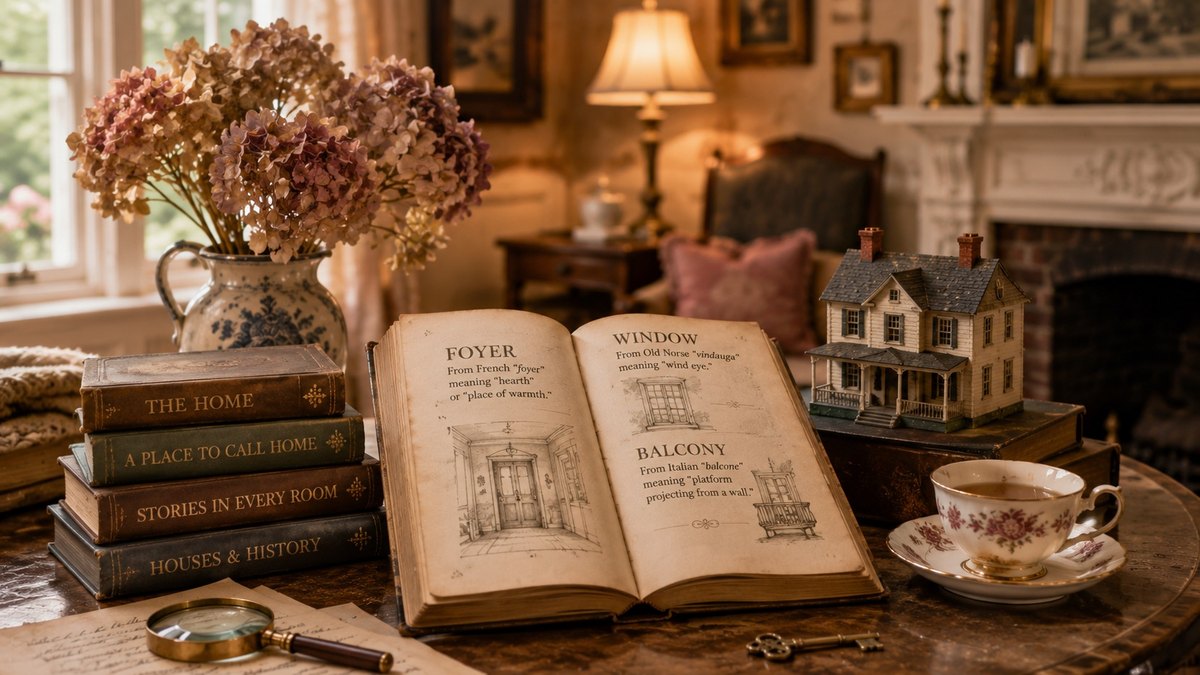
I spend a lot of my working life saying words that nobody stops to think about. Escrow. Foyer. Earnest money. Cul-de-sac. Most of them turn out to have a history that is stranger than the thing they describe, and a few of them have origin stories that are confidently repeated and completely made up. Here is the real version, with the fakes labelled.
Hindi baṅglā · first known use 1676
Literally “house in the Bengal style.” It comes into English through Gujarati from Hindi, and the original sense is a one-storey thatched house wrapped by a verandah.
Which means the porch is not a decorative afterthought. The verandah is part of the original definition, imported whole from Bengal along with the word. Every Craftsman bungalow in Fairmount is carrying a piece of colonial Bengal on the front of the house.
French foyer, “fireplace” · English 1859
It enters English in 1859 meaning the lobby of a theatre or opera house, from the French for the green room — the room where actors waited when not on stage.
But the literal French meaning is fireplace, from Old French foier (furnace, stove, hearth), from Latin focarium, from focus, hearth. The actors waited in the room with the fire in it.
Your foyer is, etymologically, a fireplace — from the same Latin focus that gives us the word focus.
Old French parleor, “to speak” · c. 1300
The parlor is named for talking. The chain is long and worth following:
c. 1200 — a window through which confessions were made. Early 1300s — a room in a monastery where those under vows of silence could speak with outsiders. Late 14th century — a room off the main hall offering some privacy. Early 15th — the public room of a private house. 16th — the ordinary sitting room of a family. 1884 — a show room for a business, hence the ice cream parlor. 1894 — beauty parlor, massage parlor.
A monk who had sworn not to speak could speak there. Which makes “funeral parlor” the strangest possible destination for the word.
Old English denn, an animal’s lair
The semantic drift here is the fun part. Old English denn meant a wild animal’s lair, a hollow place in the earth used for concealment and shelter, from a Proto-Indo-European root meaning “low ground.”
13th century — the secret lurking place of thieves. 14th — a private chamber. c. 1771 — a small room for work or leisure, and notably it starts as colloquial usage before becoming standard. The pejorative sense persists right through the 19th century in “den of iniquity.” And only by 1956, in America, does it settle into meaning a family all-purpose room.
Your den was an animal’s burrow, then a thieves’ hideout, then a gentleman’s study, and did not become a family room until the 1950s.
Attested 1787 — the same year as the Constitution
There is a story that circulates constantly: that Victorians called it the “death room” because bodies were laid out there, and that Ladies’ Home Journal renamed it the “living room” around 1910 to break the association.
It does not survive contact with the dictionary. “Living room” is first attested in 1787, or 1795 depending on which dictionary you use — more than 120 years before the supposed coinage. Whatever a magazine may or may not have printed in 1910, it did not name anything into existence.
What is true: home funerals were genuinely normal in the 19th century, and the undertaking trade adopted the domestic vocabulary of the house it was replacing. That is why we say funeral parlor. The borrowing went the other direction from the story.
Romanticised from the medieval great hall
Descended, in aspiration if not in fact, from the medieval great hall — one large central room where everything happened.
The modern American timeline: 1950s–60s, Joseph Eichler pioneers the “multipurpose room” in modernist California houses. 1970s–80s, high-end developers adopt it, often by vaulting the entryway of a ranch house. Early 1990s, nearly ubiquitous in American suburban construction. 2007, Money magazine declares great rooms “a fad whose time had passed.”
The irony worth naming: the great room was invented to fix the dead formal living room, a room nobody used. Then it got so big that people stopped using parts of it.
Middle Dutch waghenscote · mid-14th century
Originally it did not mean a treatment at all. It meant imported oak of superior quality — timber that resisted warping and had no knots, unlike English oak.
The etymology is probably Middle Dutch or Middle Flemish waghenscote, combining waghen (related to “wagon”) and scote (partition, crossbar) — the theory being that the wood was first used for wagon and coach building. Be honest about the uncertainty, though: the dictionary itself notes that connection “remains unclear,” and the earlier Dutch forms are not documented as early as the English word.
By the 1540s it means panels lining the walls of rooms; wainscoting as a gerund follows by the 1570s.
Wainscoting was not something you did to a wall. It was a grade of imported timber. It described the wood, not the woodwork.
No documented origin — and I looked
I am including these three specifically to tell you I could not source them, because a lot of articles will confidently tell you otherwise.
Mudroom — no first-use date I could verify. The word is transparently compositional and the concept is obviously Northern and agricultural, but that is inference, not a citation.
Powder room — what is documented is only its function: in American English it is a euphemism, used to conceal the room’s actual purpose, for a half bath containing a toilet and a sink. The widely repeated origins — an 18th-century room for applying wig powder, or a ship’s powder magazine — I could not verify at all.
Jack-and-Jill bathroom — nothing. No dictionary entry, no dated first use, no documented origin. The nursery-rhyme derivation is obvious enough to assume, and assuming is not the same as knowing.
The same thing, named differently everywhere
The regional name map is genuinely charming, and useful if you have buyers relocating:
Granny flat or annex in Australia and the UK. In-law suite or mother-in-law suite in the U.S., emphasising multigenerational use. Laneway house in Canada, because it faces a back lane. Ohana dwelling unit in Honolulu — ohana is Hawaiian for family. Einliegerwohnung in German-speaking countries. Friggebod in Sweden. Sleepout in New Zealand. Plus coach house, garden suite and guesthouse for detached versions.
The regulatory history is worth knowing too: Canada actively supported secondary suites from 1929 through the 1950s during the Depression and postwar housing shortages, and California limited local authority to ban them in 2016.
These are the ones I say out loud most often, and the ones people nod along to without ever asking what they mean.
Latin res, “thing” · the phrase c. 1660s
This is the one I most enjoy correcting, because the wrong answer is everywhere in my own industry. “Real” has nothing to do with “royal.” It is not land held from the king.
Real comes from Old French reel, from Late Latin realis, “actual,” ultimately from Latin res — property, goods, matter, thing. It enters English in the early 14th century meaning “actually existing.” By the mid-15th it has a legal sense, “relating to things,” paired against personal to distinguish immovable from movable property. The phrase “real estate” appears around the 1660s.
Real estate is not royal estate. Real property is thing-property — the stuff that stays put. Everything else is personal.
Old French morgage, “dead pledge” · late 14th century
The death pledge is real. From Old French, literally mort (dead) + gage (pledge), from Latin mortuus, past participle of mori, to die. First recorded in English in the late 14th century.
But the usual telling — “the pledge dies when you pay it off” — is only half of it. A 1664 legal explanation says the deal is dead either way: if the borrower fails to pay, the land “is taken from him for ever, and so dead to him”; and if he does pay, “the pledge is dead as to the tenant.”
It is a death pledge in both directions. Pay it and the pledge dies. Don’t, and the land dies to you.
Old French escroe, “a scrap of parchment” · 1590s
From Anglo-French escrowe, from Old French escroe — scrap, small piece, rag, tatter, single parchment — and behind that a Germanic root about cutting, Old High German scrot, “a scrap, a piece cut off.”
The original legal meaning is entirely about the document: “a writing fully executed by the parties, but put into the custody of a third person to hold until the fulfillment of some condition.” It did not mean money at all until 1888.
And the best part: escrow and “shred” are the same word, both from roots about cutting things up.
Escrow began as a scrap of parchment — the physical document handed to a neutral third party.
Medieval · also called God’s silver
A medieval custom, known variously as an earnest penny, an Arles penny, or God’s silver — in Latin Argentum Dei. Money or a valuable token given to bind a bargain, and notably the original use was for the purchase or hiring of a servant. Black’s Law Dictionary records a medieval transaction where the recipient took a silver three-pence piece as God’s silver to seal the agreement.
Modern American practice is typically 1–3% of the purchase price, held in trust or escrow until closing. The function has not changed in seven hundred years: you put something at risk to prove you mean it.
Old English þrescold · origin genuinely uncertain
You have probably heard the story: floors were dirt, so people spread thresh (straw), and a board at the door held the thresh in — hence thresh-hold.
It is false. It comes from a viral chain email of invented etymologies called “Life in the 1500s.” The “-hold” is a later English reshaping of a lost Germanic element, not a board. The dictionary is unusually candid here: the origin is “probably much altered by folk-etymology,” and the second element “has been much transformed in all the Germanic languages” with its literal sense lost in ancient times.
But here is the twist. The linguist Anatoly Liberman revived an older theory that the second element is a Proto-Germanic instrumental suffix, and that the original sense of threshold was “a threshing area adjacent to the living area of a house.”
The fake story is wrong about the board. Grain may be involved anyway.
French, “bottom of a sack” · a medical term first
Literally the bottom of a bag: from Latin culus, bottom or backside, plus saccus, sack.
And the order of the two first-use dates is the joke. 1738 — an anatomical term, used by physicians for a diverticulum ending blindly, a dead-end structure in the body. 1819 — nearly a century later, repurposed for a street closed at one end.
Your cul-de-sac was a medical term for a dead-end body cavity for eighty years before it was ever a street.
Changed in Texas, in June 2020
This one has a local angle that almost nobody knows, and the version you have probably heard is wrong in a specific way.
The National Association of REALTORS® did not make this change. NAR declined to. The change came from a local MLS — and the first big one was in Texas.
On June 15, 2020, the Houston Association of REALTORS® replaced “master bedroom” and “master bathroom” with “primary bedroom” and “primary bath” across its MLS and on HAR.com. It was one of nine terminology review requests submitted by its own members. HAR’s stated reasoning was member perception: “the overarching message was that some members were concerned about how the terms might be perceived,” and “primary describes the rooms equally as well as master while avoiding any possible misperceptions.” HAR did not ban the word; members could still use it in photo descriptions.
NAR publicly went the other way. Its president at the time, Vince Malta, said NAR “sees no reason that real estate professionals cannot use the term, as there is also no evidence that it has any historical connection to slavery or any other kind of discrimination.”
Two things I will not tell you, because I could not verify either: that the term originated in a 1926 Sears catalog — repeated everywhere, confirmed nowhere — or that it has a documented historical link to slavery. HAR’s own stated reason was how the word lands now, and that is the honest framing.
The change that swept American real estate started in Texas, at the Houston Association of REALTORS® — and the national association declined to join it.
People mix these up constantly, including people who should not. Here they are clean.
| Word | What it actually is |
|---|---|
| Gable The triangle, not the wall | The generally triangular portion of a wall between the edges of intersecting roof pitches. Hip roofs have no gables. “Gable wall” or “gable end” means the whole wall including the rectangle below the triangle. Front-gabled means the gable faces the street; side-gabled means the ridge runs parallel to it. That single distinction is what separates a shotgun house from a bungalow. |
| Eaves Old English efes, “edge” | The edges of the roof that overhang the face of a wall. Their job is to throw rainwater clear. And a nice footnote: “eaves” is singular in origin — it was never a plural, despite the s. |
| Fascia The face | The board running the length of the eaves beneath the roof covering. It caps the exposed rafter ends, and it is what your gutter is screwed to. |
| Soffit The underside | The horizontal panel on the underside of the eaves, running back to the wall. It seals the gap between rafters against weather and pests. |
| Dormer Middle French dormeor, “sleeping room” | A roofed structure, usually containing a window, projecting vertically beyond the plane of a pitched roof. It is named for sleeping because dormers lit attic bedrooms. In British domestic architecture since the 16th century; François Mansart popularised them in 17th-century Paris mansard roofs. |
The mnemonic that actually works: the eaves are the overhang. Fascia faces you; the soffit is what you see looking up.
A shotgun house is a single-storey frame house with three to five rooms in a straight line and no interior hallway. Two things get said about the name, and they need to be kept apart.
The architectural origin. The folklorist John Michael Vlach traced the house form to Saint-Domingue — Haiti — and ultimately to West African building traditions, arriving in New Orleans with free people of color after the Haitian Revolution. The Mississippi Encyclopedia endorses it and notes that although some scholars of vernacular architecture question it, “his model remains the standard interpretation.” The main academic critic, Jay D. Edwards, argues the direct Haitian-refugee link is not supported by enough evidence — while acknowledging that later scholarship has produced supporting evidence for shotgun-like structures between 1805 and 1840.
The word. Separately, it is often said that “shotgun” derives from a Dahomey Fon term to-gun, “place of assembly,” misheard and reinterpreted. Note that Vlach’s own phrasing was that it “may have originated” there. It was offered as a hypothesis and it has not been confirmed by lexical evidence. No dictionary gives it — not the OED, not Merriam-Webster, not Etymonline. And the earliest documented use of the term in print is a classified advertisement in the Atlanta Journal-Constitution of August 30, 1903 offering “good shot-gun houses in good repair” — a full century after the migration the theory depends on.
The competing explanation, from the architectural historian Samuel Wilson Jr., is the obvious one: open all the doors and a shotgun blast fired through the front door exits the back cleanly.
So: the African origin of the form is the standard scholarly interpretation. The African origin of the word is unconfirmed. Both things can be true at once, and they usually get collapsed into one claim that overstates the evidence for the second.
“The attractiveness of the exterior of a property as viewed from the street.” I could not find a first-use date from any dictionary. What is documented is only that the term was used extensively in the United States during the housing boom. If somebody tells you it was coined in a particular year, ask them where.
Partly because it is fun, and I make no apology for that. But there is a real point underneath it.
A lot of what gets said in real estate is repeated rather than known. “Real means royal.” “Living room was invented to escape the death room.” “NAR changed master bedroom.” Every one of those is confidently repeated by people in my industry and every one of them is wrong — and they are the harmless examples. The same habit produces “wallpaper costs you five percent” and “you should always price high and negotiate down,” which cost people actual money.
The words are a low-stakes place to practise the useful reflex, which is asking where a claim came from before you repeat it. Including when I am the one saying it.
Not because of royalty. 'Real' comes from Old French reel, from Late Latin realis meaning 'actual,' and ultimately from Latin res, meaning 'property, goods, matter, thing.' It entered English in the early 14th century meaning 'actually existing,' and by the mid-15th century carried a legal sense of 'relating to things,' paired against 'personal' to distinguish immovable from movable property. The phrase 'real estate' appears around the 1660s. Real property is thing-property; everything else is personal property.
Yes. It comes from Old French morgage, literally 'dead pledge,' from mort meaning dead and gage meaning pledge, and it is first recorded in English in the late 14th century. The usual explanation, that the pledge dies when the loan is repaid, is only half of it. A 1664 legal explanation describes the deal as dead either way: if the borrower fails to pay, the land is taken from him forever and so is dead to him; and if he does pay, the pledge is dead as to the tenant.
A scrap of parchment. Escrow comes from Anglo-French escrowe, from Old French escroe, meaning scrap, small piece, rag or single parchment, and behind that a Germanic root about cutting. It entered English in the 1590s with a purely documentary meaning: a writing fully executed by the parties but placed with a third person to hold until a condition is fulfilled. It did not mean a deposit of money until 1888. Escrow and 'shred' are ultimately the same word.
The Houston Association of REALTORS, on June 15, 2020, which replaced 'master bedroom' and 'master bathroom' with 'primary bedroom' and 'primary bath' across its MLS and on HAR.com. It was one of nine terminology review requests submitted by members, and HAR's stated reason was member perception rather than documented history. The National Association of REALTORS did not make the change and publicly declined to, with its president stating that NAR saw no reason the term could not be used. Claims that the term originated in a 1926 Sears catalog are widely repeated but unverified.
From Hindi bangla, literally 'house in the Bengal style,' reaching English through Gujarati with a first known use of 1676. The original sense was a one-storey thatched house wrapped by a verandah, which is why the porch is part of the definition rather than an addition to it.
No. The story that floors were dirt, that people spread thresh or straw on them, and that a board at the door held the thresh in, comes from a widely circulated chain email of invented etymologies. The '-hold' element is a later English reshaping of a lost Germanic element, not a board. The dictionary describes the origin as uncertain and probably much altered by folk etymology. Ironically, the linguist Anatoly Liberman has revived an older scholarly theory that the original sense was a threshing area adjacent to the living area of a house, so grain may be involved after all, just not in the way the story says.
Buying or selling and want the plain-English version? I will tell you what every line in the contract actually does, which parts are negotiable and which are not, and where the language is protecting you rather than the other side.
Walk me through itChecked August 2026. Where sources disagree on a date or a figure I have said so in the text rather than quietly picking one.

REALTOR® · BHHS PenFed Realty Texas
I help buyers and sellers across the Dallas–Fort Worth Metroplex — Fort Worth, Burleson, Crowley and Keller, and the surrounding Dallas area. I write these because they are the questions I answer on the phone every week, and most people never get a straight answer to them. If you have one I have not covered, ask me — I will probably turn it into the next post.