
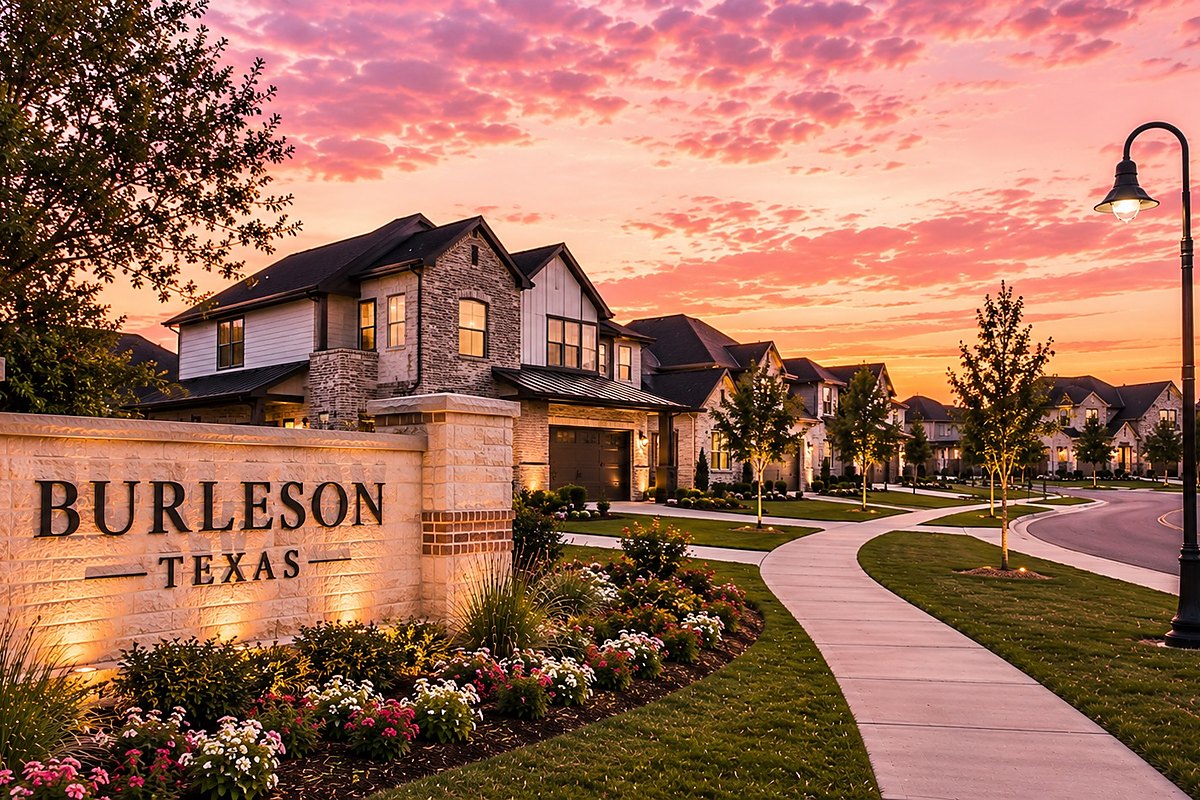
I get asked about Burleson’s history more than you would think. Usually it comes up on a drive between showings, somewhere on Renfro, when a buyer looks out the window and says “so what was all this?” The short answer is that it was a railroad depot named after a man who, as far as anyone can tell, never lived here. The long answer is better.
There were people farming this land before there was a Burleson. A settlement called Brushy Mound sat about a mile north of where Old Town is now, and it had what a settlement needed — families, farms, and by 1879 a school.
Then the railroad came through and did not stop there. Brushy Mound was bypassed, the new depot went up a mile south, and over the following century the older community was absorbed into the city limits of the town that replaced it. Its school eventually moved into Burleson in 1900. If you want the one-sentence version of how North Texas towns were made and unmade in the 1880s, that is it: the rail line decided, and everything else rearranged itself around the decision.
The Missouri, Kansas and Texas Railroad — the Katy — was planning a route from Fort Worth to Hillsboro and needed a depot along it. A railroad representative named Grenville M. Dodge acquired the land for it from Rev. Henry C. Renfro, a Johnson County preacher and farmer.
Small historical knot worth knowing: the Texas State Historical Association says Dodge purchased the land from Renfro. The 1970 state historical marker on the Renfro-Clark House calls Renfro the donor of the townsite. Both are reputable. Everyone agrees he conveyed it; they disagree on whether money changed hands.
As part of the deal, Renfro got to name the depot. He named it for Dr. Rufus C. Burleson — his old teacher at Baylor, and later Baylor’s president.
Rufus Columbus Burleson was born in Alabama in 1823, pastored the First Baptist Church of Houston, and in 1851 became the second president of Baylor University. He ran Waco University through the Civil War years, then led the merged Baylor from 1886 to 1897. He died in Waco in 1901.
Here is the part people like: no source I can find places him in this town at any point. His whole life traces through Alabama, Independence, Houston and Waco. Burleson, Texas is named after a Baylor administrator whose connection to it was one grateful former student.
Renfro was born in Tennessee in 1831, studied under Burleson at Baylor, served in the Civil War — first in the infantry, later as a chaplain, an appointment Burleson helped him get — and founded Bethesda Baptist Church here in Johnson County.
Then, in February 1884, the Baptist church dismissed him for “advocating and preaching the doctrine of infidelity.” He spent his last years as a free-thought lecturer. He died in 1885 of pneumonia he caught on a cattle drive to Fort Worth, and he is buried at the Bethesda church he started. The man who named this town for a Baptist university president was excommunicated by the Baptists three years later.
His name is still on the map. Renfro Street runs through Old Town, and City Hall sits on it.
Burleson got a post office in 1882. The first postmaster was John L. Dickey, and he ran it out of a saloon. I did not make that up and I am not going to stop telling people.
For its first fifty years this was a farm town, and the crop was cotton, supported by grain and livestock and an artesian well that supplied the town with water. The Handbook of Texas records what shipped out of here in 1899:
By 1890 the town had grocers, druggists, a general store and several cotton gin-gristmills, and a population of about 200. It had also survived a disaster: a fire in 1895 burned down most of the business district along with several houses.
In 1911 a group began planning an electric interurban line from Fort Worth to Cleburne by way of Everman, Burleson and Joshua. The first public run came through Burleson on September 1, 1912 — reportedly carrying 1,200 passengers across ten runs that opening day.
For nineteen years, a small farm town had electric rail service to a major city. It brought Burleson electricity in 1913. Lone Star Gas arrived in 1921. And it built the block that is now the heart of Old Town: the traction company put up an orange-brick building on Ellison Street in 1912 with a soda fountain, a pharmacy run by Albert H. Loyless, and an interurban ticket counter, plus an electrical plant and freight dock behind it.
That building is still standing. It is the Burleson Museum and Visitors Center at 124 W. Ellison Street. Loyless moved out in 1935 to become Burleson’s postmaster; the Burleson News was published from it afterward; the city eventually bought it.
The line closed in 1931, killed by the automobile and the Depression. Two of its rail cars survive here — the #330 and the #411 parlor car — and both were worked into the design of Mayor Vera Calvin Plaza. Old Town’s current renaissance is, physically, built around the wreckage of a streetcar line that has not run in ninety-five years.
The same year the interurban arrived, Burleson incorporated. It had roughly 700 residents and a working business district. It adopted a home rule charter by election on April 5, 1969, and it operates under a council-manager form of government to this day.
This is the table I wish more people saw before they tell me Burleson “used to be a small town.” It was a small town for a very long time, and then it stopped, quite suddenly, in the 1950s.
| Year | Population | Change |
|---|---|---|
| 1890 | ~200 | — |
| 1920 | 241 | — |
| 1930 | 591 | +145% |
| 1940 | 573 | −3% |
| 1950 | 791 | +38% |
| 1960 | 2,345 | +196% |
| 1970 | 7,713 | +229% |
| 1980 | 11,734 | +52% |
| 1990 | 16,113 | +37% |
| 2000 | 20,976 | +30% |
| 2010 | 36,690 | +75% |
| 2020 | 47,641 | +30% |
| July 2025 (estimate) | 56,907 | +19.5% |
Decennial census counts through 2020; the 2025 figure is the Census Bureau’s July 1, 2025 population estimate. There are no 1900 or 1910 city counts — Burleson was not incorporated yet, so it did not appear as a place. The 1890 figure is a community estimate rather than a census count.
Look at 1950 to 1970. The town went from 791 people to 7,713 in twenty years — nearly a tenfold increase — and it is not a mystery why.
U.S. 81 was completed as a four-lane divided road in 1955. In 1957 it was redesignated Interstate 35W. In 1976, the state highway department reconstructed and widened it to six lanes with frontage roads all the way from I-20 down to Burleson, at a cost of $12.9 million.
Overlay that on the table above and the story writes itself. Burleson did not grow because of cotton or the railroad. It grew because it became possible to live here and work in Fort Worth. It stopped being a farm town and became a suburb, and the census caught it happening in real time.
The Chisholm Trail Parkway opened in May 2014 — a 27.6-mile, roughly $1.4 billion toll road running from I-30 in downtown Fort Worth to U.S. 67 in Cleburne, the North Texas Tollway Authority’s first road in Tarrant and Johnson counties. At its FM 917 interchange it clips the southwestern tip of Burleson.
If I-35W made Burleson a commuter town, the parkway made the western half of it developable. Every major project now under way out there — Tallgrass at FM 1902, Chisholm Summit — is oriented to that road. It was not built on the historic cattle trail, incidentally. It was originally called the Southwest Parkway and was renamed by legislation in 2011.
| Measure | Figure |
|---|---|
| Population (July 2025 estimate) | 56,907 |
| Land area (2020) | 28.26 sq mi |
| Median household income | $93,928 |
| Median owner-occupied home value | $308,200 |
| Owner-occupied housing rate | 72.1% |
| Median gross rent | $1,685 |
| Median age | about 35 |
| Mean travel time to work | 30.9 minutes |
| Bachelor’s degree or higher (25+) | 34.0% |
Census Bureau QuickFacts. Income, value, rent, age and commute figures are American Community Survey 2020–2024 five-year estimates in 2024 dollars — averages across that window, not a single-year snapshot. Median age comes from Census population data rather than QuickFacts, which does not publish it. The city has annexed its way from about 26 square miles in 2010 to 28.26 in 2020, so some of what looks like growth is boundary rather than people.
Two things in that table I want to flag, because they explain a lot about who moves here. The median household income is $93,928 and the median home value is $308,200. That is a genuinely healthy ratio for the Metroplex in 2026, and it is the whole reason a young family looking at Fort Worth ends up looking at Burleson.
The other is the 30.9-minute average commute. Burleson is still, statistically, a town people sleep in and drive out of. The city’s push on the industrial park, the medical corridor around Texas Health Huguley, and Chisholm Summit’s planned office park are all aimed at moving that number.
This trips up more buyers than anything else on this page. Burleson sits in two counties. Most of the city is in northern Johnson County; a smaller northern portion is in southern Tarrant County. Which one you are in determines which appraisal district values your home — Johnson County Central Appraisal District or Tarrant Appraisal District — and the city levies in both.
And a Burleson address can fall in any of five school districts depending on where it sits: Burleson ISD, Joshua ISD, Crowley ISD, Everman ISD or Mansfield ISD. Joshua ISD alone operates four campuses inside Burleson. Burleson ISD serves about 12,621 students across 20 campuses.
Never assume a Burleson address means Burleson ISD. Verify the attendance zone for the specific street address, every single time. I do this before I show a house, not after.
Kelly Clarkson grew up in Burleson and graduated from Burleson High School in 2000, raised by her mother, a first-grade teacher, and her stepfather, a contractor. Before she left for Los Angeles she worked at a movie theater, at an Eckerd drugstore, and waited tables at a comedy club. She got a standing ovation for a choir solo in junior high and played Fiona in the high school production of Brigadoon. Two years after graduating she won the first season of American Idol.
Robert B. Anderson, born in the Burleson area in 1910, served as Eisenhower’s Secretary of the Navy and then Secretary of the Treasury from 1957 to 1961. Country musician Casey Donahew is also from here, and Olympic skeet silver medalist Conner Prince and volleyball national-teamer Stacy Sykora both came out of Burleson.
More than you would think, and here is the honest version.
Burleson has gone through exactly two step-changes in 145 years, and both were transportation. 1957 gave it a highway; 2014 gave it a second one. Both times, the growth followed the road by about a decade, and both times the land nearest the new road appreciated first.
We are currently about twelve years past the second one. That is roughly where you would expect the master-planned communities to start breaking ground — and that is exactly what Tallgrass and Chisholm Summit are. Whether the pattern repeats a third time is not something I can promise anybody. But it is a good deal more useful than “now is a great time to buy.”
The other thing worth saying: the population table above shows a town that has roughly doubled every twenty years since 1970. If that continues, the Burleson your kids graduate from will not be the Burleson you moved into. Some people read that as the reason to buy here. Some read it as the reason not to. Both are defensible; just make sure you are reading the same numbers.
Burleson is named for Dr. Rufus C. Burleson, a Baptist minister who served as president of Baylor University. The town was named by Rev. Henry C. Renfro, who had studied under Burleson at Baylor and who conveyed the land for the railroad depot and townsite in 1881. No source indicates that Rufus Burleson ever lived in the town named for him.
The town dates to 1881, when the Missouri, Kansas and Texas Railroad established a depot on the site while planning a route from Fort Worth to Hillsboro. A post office followed in 1882, and the city incorporated in 1912 with roughly 700 residents.
The U.S. Census Bureau estimated Burleson's population at 56,907 as of July 1, 2025. The 2020 census counted 47,641, meaning the city added roughly 9,300 people, about 19.5 percent, in five years. In 1920 the population was 241.
Both. Most of Burleson is in northern Johnson County, with a smaller northern portion extending into southern Tarrant County. Property in the Johnson County portion is appraised by Johnson County Central Appraisal District and property in the Tarrant portion by Tarrant Appraisal District. Note that Burleson County, Texas is an entirely different place near Bryan and College Station.
A Burleson address may fall in Burleson ISD, Joshua ISD, Crowley ISD, Everman ISD or Mansfield ISD depending on its exact location. Joshua ISD operates four campuses inside Burleson. Always verify the attendance zone for the specific address rather than assuming a Burleson address means Burleson ISD.
Yes. Kelly Clarkson grew up in Burleson and graduated from Burleson High School in 2000, two years before winning the first season of American Idol.
Curious what your corner of Burleson is actually worth? Texas is a non-disclosure state, so no website has the closed sale prices. I do.
Get my home’s valueFigures current as of August 2026. Populations, prices, city projects and business openings all move — if you are relying on a number here, ask me and I will check it.

REALTOR® · BHHS PenFed Realty Texas
I help buyers and sellers across the Dallas–Fort Worth Metroplex — Fort Worth, Burleson, Crowley and Keller, and the surrounding Dallas area. I write these because they are the questions I answer on the phone every week, and most people never get a straight answer to them. If you have one I have not covered, ask me — I will probably turn it into the next post.