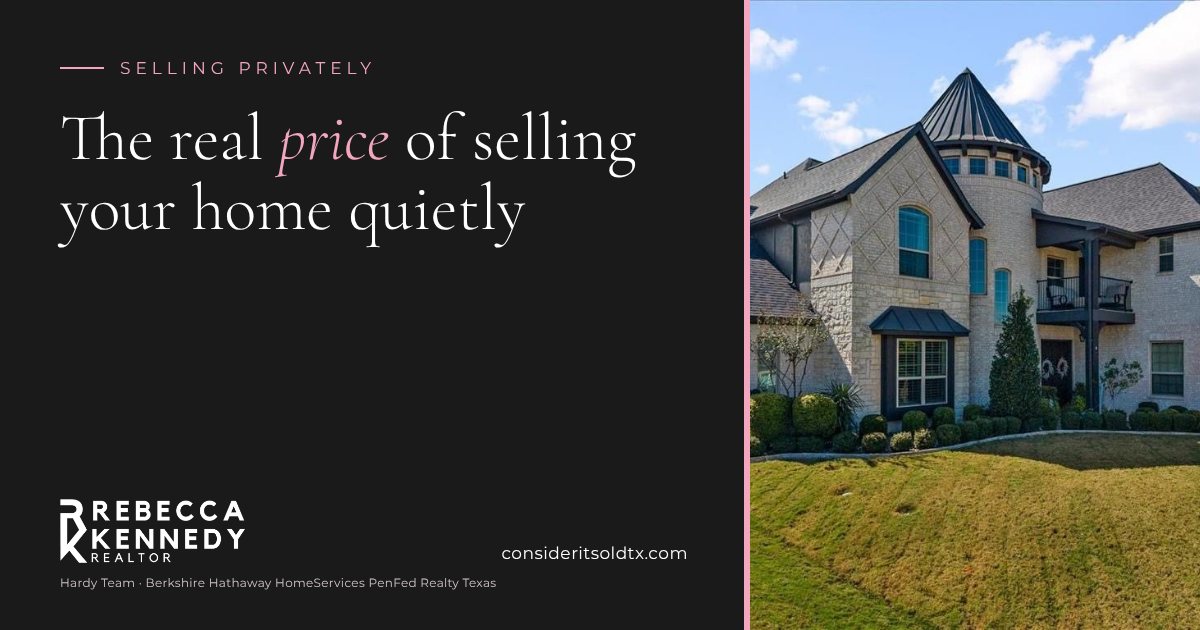
If you own a high-end home in Fort Worth and you do not want strangers walking through it, a private sale sounds perfect. It can be the right call. But here is what you need to hear first: privacy has a price, and that price is exposure. Fewer buyers see your home, and nobody can honestly promise you that a quiet sale brings more money. Anyone who does is selling you something.
People use the phrase for several different things, and they are not the same.
When someone offers you an "off-market" plan, ask which one they mean. The rules and the exposure change with each.
In North Texas, that rule is NTREIS MLS Rule 7.01, known as clear cooperation. According to MetroTex's May 2026 explanation, the listing broker must submit a listing to the MLS within one business day of marketing it to the public. Business days leave out weekends and federal and state holidays.
"Public marketing" is broader than most sellers expect. It includes yard signs, social media posts, email and text blasts, flyers and public websites. So a quiet sale has to stay quiet. A single post can start the clock, and a yard sign with a Coming Soon rider does not meet the rule unless the listing is actually in the MLS. The rule covers most residential property, including farm and ranch, lots and acreage, and buildings up to four units. It does not cover leases or commercial listings.
The National Association of Realtors kept clear cooperation in March 2025 and added options for sellers. A seller can direct that a listing not be shared through the MLS and not be publicly marketed. Under NAR's policy, the broker needs a signed certification showing the seller understands what MLS benefits are being given up. NAR also created a delayed marketing option, with the length set by each local MLS. MetroTex's explanation does not describe a separate delay period for North Texas, so ask your broker what is available when you are ready.
For many sellers, Coming Soon is the better first step. In NTREIS a listing can sit in Coming Soon for up to 30 days, then it converts to Active on day 31. It does not build days on market and it is not sent to sites like Zillow or Realtor.com. Other agents can still find it in the MLS, and it can appear in client portal emails. Since Oct. 8, 2025, you can decide whether showings are allowed during that period.
You get a quiet start with real agent exposure. The downside is that it has an expiration date.
The honest answer is that the research disagrees, and most of it comes from companies with something at stake.
That Georgia paper is the one most relevant to us, and it should make you careful in both directions. It does not prove a private sale will beat the market on your home today. Lawmakers are paying attention too. A House antitrust subcommittee sent letters about private listing networks this summer, and fair housing concerns have been raised about who gets access to hidden inventory. Any plan that limits who can see a home deserves that question.
Rules change, so confirm them with your broker when you are ready, and bring legal questions to a real estate attorney. If privacy is worth more to you than the widest possible market, that is a legitimate choice. It just should be a choice you made with the numbers in front of you. Here are more questions for any luxury agent.
Yes, sellers can choose not to market publicly. MLS members in North Texas still have to follow NTREIS rules, including the one-business-day rule once a home is publicly marketed. Your attorney and broker can confirm how that applies to you.
The research conflicts. Zillow found lower prices, Compass found higher ones, Bright MLS found no impact, and a University of Georgia paper on DFW found a premium that faded after 2020. None of that predicts your sale.
Coming Soon in NTREIS is visible to other MLS members and lasts up to 30 days. An office exclusive is filed with the MLS but shared only within the listing brokerage, so far fewer agents can bring a buyer.
Weighing privacy against exposure? Book a confidential conversation and we can talk through your options, or read how I approach selling a home.

REALTOR® · BHHS PenFed Realty Texas
I help buyers and sellers across the Dallas–Fort Worth Metroplex — Fort Worth, Burleson, Southlake, Crowley and Keller, and the surrounding Dallas area. I write these because they are the questions I answer on the phone every week, and most people never get a straight answer to them. If you have one I have not covered, ask me — I will probably turn it into the next post.